

Last updated: August 2026
“AI agent” is everywhere in 2026 — on product pages, in job titles, in nearly every company’s roadmap slide. It’s also one of the most overused and under-defined terms in tech right now, which means most explanations either drown you in architecture diagrams or oversimplify to the point of being wrong. Here’s the actual, working definition, how agents differ from the chatbots and assistants you already use, and — because this matters more than most explainers admit — how to tell a real one from a relabeled chatbot with a new coat of paint.
The Core Definition
An AI agent is a software system that’s given a goal rather than a single instruction, and can plan a sequence of steps, use tools to carry them out, check its own progress, and adjust — often completing multiple steps without you approving each one individually.
Compare that to a standard AI assistant or chatbot: you ask a question, it gives you an answer, the interaction ends. One request, one response. An agent is different because it keeps going. Give it a goal like “find our three biggest competitors’ current pricing and flag anything that changed this month,” and instead of a single reply, it searches the web, opens pages, reads them, compiles a comparison, and hands you a finished result — all from one instruction.
The simplest test: if you gave a tool one instruction and it’s still doing things five minutes later without you prompting it again, that’s agentic behavior. If it produced one output and stopped, that’s assistant behavior, regardless of what the product page calls it.
How AI Agents Actually Work
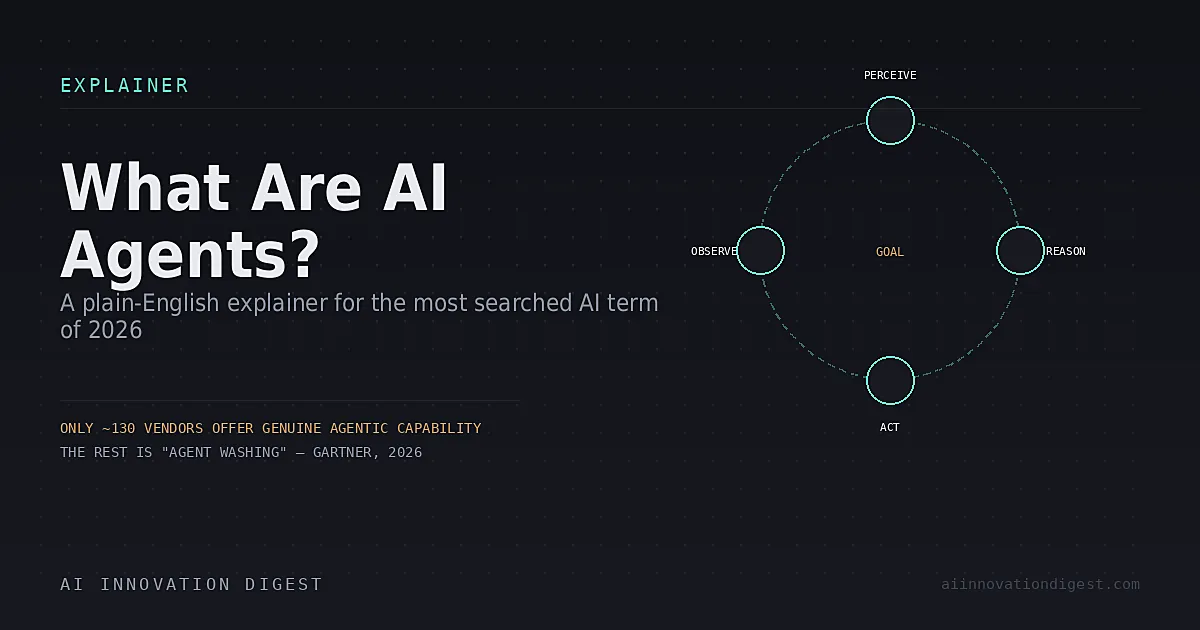
Most AI agents run on a repeating loop, commonly described as perceive, reason, act, observe — repeated until the goal is met or the agent hits a limit:
- Perceive — the agent takes in the current situation: your instruction, the state of a file, an email inbox, a webpage.
- Reason — using a large language model as its “reasoning engine,” it plans what to do next and breaks the goal into steps.
- Act — it uses a tool to actually do something: run a search, edit a file, call an API, click a button in a browser.
- Observe — it checks the result of that action against the goal, and either continues, adjusts course, or stops.
That loop is what separates an agent from a script. A traditional automation follows a fixed sequence you wrote in advance — if X happens, do Y. An agent decides its own sequence of steps in response to what it finds along the way, which is what lets it handle situations you didn’t explicitly program for.
Memory is the other piece that matters: agents that are actually useful over time typically retain some record of past interactions, so they don’t start from zero on a similar task next week. This is also where “multi-agent systems” come in — instead of one agent doing everything, specialized agents (a research agent, a writing agent, an editing agent) hand work off to each other, similar to how a small team would split a project.
Real Examples
- A research agent given “compare three cloud providers by price and support terms” will search, open pages, extract the relevant numbers, compile them into a table, and flag contradictions — without you telling it which pages to open.
- A coding agent given “find and fix the failing test” will run the test suite, read the error output, edit the relevant code, and rerun the tests until they pass or it hits a retry limit.
- A scheduling agent can manage an entire meeting-booking process — emailing participants, finding open calendar slots, and confirming a time — from a single instruction, without you sending a follow-up message.
- A monitoring agent can check competitor websites, pricing pages, and product launches on a schedule, decide which changes actually matter, and compile a short brief — a genuinely open-ended task that’s also low-risk, since the output is an internal summary rather than something published publicly.
Why “AI Agent” Has Become a Marketing Word (And How to Spot It)
Here’s the part most explainers skip, and it’s arguably the most useful thing to know before you evaluate any product that calls itself an agent: a lot of what’s sold as an AI agent isn’t one.
Gartner coined the term “agent washing” to describe vendors rebranding existing chatbots, virtual assistants, and rule-based automation as agentic AI without delivering genuine autonomous capability. Gartner estimates that of the thousands of vendors currently marketing agentic products, only around 130 offer real agentic functionality — the rest are, in the words of one analysis, “a chatbot with ambitions.” Gartner’s own April 2026 Hype Cycle placed AI agent development platforms at the Peak of Inflated Expectations, the stage right before a category typically works through a wave of disappointment before the genuinely useful parts settle into normal use.
The practical consequences are real. Gartner predicts that over 40% of agentic AI projects will be cancelled by the end of 2027, driven by escalating costs, unclear business value, and inadequate governance — and a widely cited MIT study found that 95% of enterprise generative AI pilots showed no measurable return. The failure pattern in study after study is consistent: broad, internally built, hype-driven deployments dropped onto legacy systems tend to fail, while narrow, purpose-built agents pointed at one specific, high-volume task with a clear success metric tend to succeed.
None of this means agents are fake or not worth using — genuine agentic capability is real, growing fast, and already useful for specific tasks. It means the label alone tells you very little. Before trusting a product’s “AI agent” claim, it’s worth asking a simple question: given one instruction, does it actually take multiple independent actions toward a goal, or does it produce a single response dressed up in agentic language? If you can’t point to the multi-step, tool-using loop described above, you’re probably looking at a chatbot with new branding.
AI Agents vs. AI Assistants
These two terms get used almost interchangeably in marketing copy, but the practical distinction matters when you’re deciding what to actually use or buy. We cover this specific comparison — with more detail on where the line actually sits and real product examples on each side — in a dedicated explainer on AI agents vs. AI assistants.
Where to Actually Use an AI Agent
Understanding the concept is the easy part — the more useful question is where a real agent earns its place in your own workflow. For business and team automation specifically, the current generation of workflow tools (Zapier, Make, and n8n among them) have all built genuine agentic features into their platforms over the past year, moving well beyond their original if-this-then-that automation model. We cover how those platforms actually compare, including their new agent capabilities, in our guide to the best AI workflow automation tools and our head-to-head Zapier vs. Make vs. n8n comparison.
The Bottom Line
An AI agent is a system given a goal rather than an instruction, capable of planning, using tools, and taking multiple independent actions toward that goal without approval at every step — genuinely different from the single-response chatbots and assistants most people are used to. The concept is real and increasingly useful for specific, well-scoped tasks. But the term has been stretched by marketing to the point where it’s applied to products that don’t actually do any of that, so the label itself should never be taken at face value. The question worth asking of any product claiming to be an agent isn’t “does it say agent” — it’s “given one instruction, does it actually keep working on my behalf, or did it just answer once and stop?”
FAQ
What’s the difference between an AI agent and a chatbot?
A chatbot responds to one message with one answer and stops. An AI agent is given a goal, plans a sequence of steps, uses tools to carry them out, and keeps working — often through multiple actions — without needing a new instruction after each step.
Are AI agents and AI assistants the same thing?
Not exactly, though the terms are often used loosely. An assistant typically completes a single task per request. An agent pursues a broader goal across multiple autonomous steps. See our full AI agents vs. assistants comparison for the detailed distinction.
What is “agent washing”?
A term coined by Gartner to describe vendors rebranding existing chatbots, virtual assistants, and rule-based automation as “AI agents” without delivering genuine autonomous, multi-step capability. Gartner estimates only a small fraction of vendors marketing agentic products actually deliver on the term.
Do AI agents actually work?
For narrow, well-defined tasks with a clear success metric, yes — genuinely and increasingly well. For broad, loosely defined deployments, the track record is weaker: Gartner predicts over 40% of agentic AI projects will be cancelled by 2027, and a widely cited MIT study found the large majority of enterprise AI pilots show no measurable return. Scope and clarity of goal matter more than the technology itself.
What are some examples of AI agents I can actually use?
Research agents that compile and cross-reference information across multiple sources, coding agents that find and fix bugs autonomously, scheduling agents that handle back-and-forth meeting coordination, and monitoring agents that track competitors or markets on a schedule are all in active, practical use today.
Sources: Gartner (“Gartner Predicts Over 40% of Agentic AI Projects Will Be Canceled by End of 2027,” June 2025, and April 2026 Hype Cycle for Agentic AI); MIT NANDA “State of AI in Business” research; Google Cloud’s AI agents overview; independent 2026 technical guides. This is a fast-moving category — adoption figures and vendor claims shift quickly, so treat statistics as directional and verify current numbers before citing them in time-sensitive contexts.