

Editorial note: Updated September 2026. AI video generation is one of the fastest-moving categories in AI — model quality, pricing, and availability change frequently. Verify current details with each provider before subscribing.
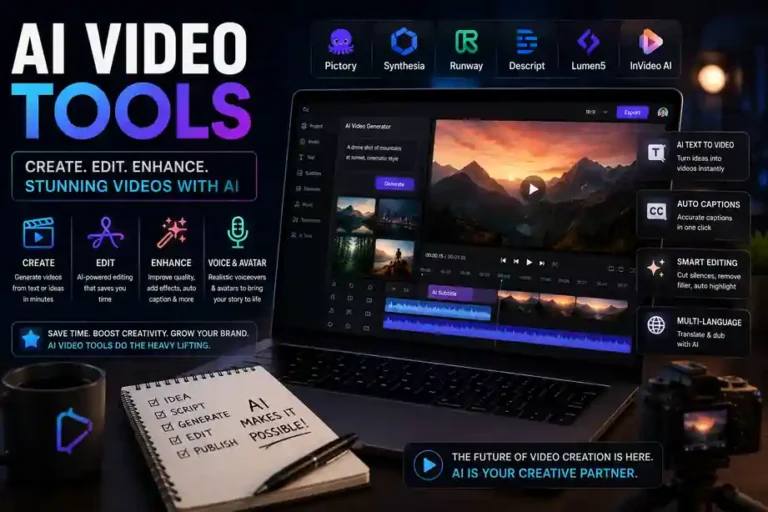
AI video tools have crossed a threshold in 2026. What was an impressive but visually rough technology in 2023 has matured into tools that produce footage good enough for professional use — commercials, social content, explainer videos, and creative projects that would previously have required a full production team. The category has also fragmented sharply: text-to-video generators, AI video editors, and AI avatar platforms each serve different needs. This guide covers the leading tools in each segment, what they actually do well, and who each one suits.
The quick summary
- Sora (OpenAI) — best overall text-to-video for complex, cinematic prompts; deepest ChatGPT integration
- Veo 3 (Google) — best for videos with native audio, dialogue, and sound design built in
- Runway Gen-4 — best for filmmakers and creative professionals who need fine-grained control
- Kling AI — best quality-to-price ratio for high-volume social content generation
- Pika 2.2 — best for quick, accessible video generation; most forgiving for beginners
- Luma Dream Machine — best for image-to-video and product visualisation
- Synthesia — best for business training, e-learning, and corporate video at scale
- HeyGen — best for video translation, localisation, and AI avatar spokespersons
- Descript — best for AI-assisted video editing, transcript-based editing, and post-production
What AI video tools can actually do in 2026
The category covers three meaningfully different capabilities:
Text-to-video generation — typing a prompt and receiving a short video clip. The best tools in 2026 produce 5–20 second clips that hold coherent motion, realistic physics, consistent characters, and cinematic framing. Longer clips and full narrative continuity remain challenges, though they are improving.
Image-to-video — animating a still image or photograph. This is useful for product shots, portraits, illustrations, and any case where you have a visual starting point and want to bring it to life. Quality here has surpassed text-to-video on many tools.
AI video editing and production — tools that work on existing footage: transcript-based editing, AI scene detection, overdubbing, background removal, and avatar insertion. These sit closer to traditional post-production software than to generative AI, though the line is blurring.
Sora
Sora is OpenAI’s text-to-video model, available through ChatGPT Plus and Pro subscriptions. It generates video clips from text prompts, remixes existing video, and supports image-to-video animation.
What makes it different: Sora produces some of the most cinematically coherent text-to-video outputs available. It handles complex spatial relationships, consistent lighting across cuts, and nuanced motion in a way that earlier tools could not. Prompts like “a wide tracking shot of a woman walking through a neon-lit Tokyo street at night” produce results that are genuinely usable in professional contexts rather than requiring heavy post-processing.
Storyboard mode lets you chain multiple clips with consistent visual style, camera movement direction, and character continuity — a step toward coherent short-form narrative video rather than isolated clips.
ChatGPT integration means you can use Claude’s context — existing images, reference videos, or a creative brief you’ve already worked on — directly in the video generation workflow.
Limitations: Sora on the Plus plan applies usage limits. Access to higher-quality outputs and longer clips is gated on the Pro tier (£200/month). Character consistency across multiple clips and very specific physical actions (hands, precise object interactions) remain challenge areas.
Pricing:
- Plus (£20/month): limited Sora access, standard quality
- Pro (£200/month): higher usage, highest resolution, longer clips
Best for: creative professionals and content creators already on ChatGPT Plus or Pro who want integrated text-to-video in their existing workflow.
Veo 3
Veo 3 is Google DeepMind’s video generation model, available through Google’s AI products including Gemini Advanced. It is the only major text-to-video tool that generates native audio — ambient sound, dialogue, music, and sound effects — alongside the video, from a single prompt.
What makes it different: native audio generation is Veo 3’s decisive differentiator. Every other text-to-video tool produces silent video that requires separate audio work. Veo 3 generates soundscapes, character dialogue, environmental noise, and basic music that are synchronised to the visual output. For content creators who want a complete draft video — visuals and audio together — this collapses a significant part of the production workflow.
Video quality is among the strongest in the category. Veo 3 produces high-resolution, fluid motion with strong handling of natural environments, weather, and realistic human movement.
Limitations: dialogue realism and lip-sync are improved but not flawless — close-up conversational shots with complex dialogue still show uncanny edges. Very long or narratively complex prompts require more iteration than shorter, visually specific ones.
Pricing:
- Gemini Advanced: included with Google One AI Premium (£18.99/month)
- API: usage-based via Google AI Studio
Best for: content creators who want the most complete single-prompt output (video + audio), and anyone producing social content, short-form clips, or visual content that needs ambient sound.
Runway Gen-4
Runway is a creative AI platform that has been at the frontier of video generation since Gen-1 in 2023. Gen-4 is its current flagship, combining text-to-video, image-to-video, video inpainting, background removal, and a full AI video editing suite.
What makes it different: Runway is the tool that working filmmakers and creative professionals actually use. Its generation quality is excellent, but what distinguishes it is the control available — reference images for character and scene consistency, camera movement controls (dolly, pan, tilt, zoom, orbit), precise motion brushing, and inpainting for selective edits to existing footage. For productions that need specific results rather than interesting random outputs, Runway’s toolset is more professional than any pure-generation competitor.
Act One is Runway’s motion capture feature: record yourself acting a scene on a webcam, and Runway transfers your movement and expressions to any character. For animators and filmmakers who need character performance, this is a genuinely powerful addition to the toolkit.
Multi-motion brush lets you paint which parts of an image should move and how — a useful tool for animating product shots, portraits, or illustrations with directional control.
Pricing:
- Basic: Free (limited credits/month)
- Standard: £12/month (625 credits/month)
- Pro: £28/month (2,250 credits/month)
- Unlimited: £76/month (no limit on standard quality)
Best for: filmmakers, visual artists, advertising producers, and creative agencies that need professional-grade video generation with precise control rather than consumer-level ease.
Kling AI
Kling is a text-to-video and image-to-video model from Chinese AI company Kuaishou. It has rapidly become one of the most-used tools among content creators due to a combination of strong visual quality, long clip generation (up to 3 minutes), and competitive pricing compared to Western alternatives.
What makes it different: Kling generates longer clips than most competitors. Where Sora and Runway typically work in 5–10 second segments, Kling supports up to 3-minute continuous video at high quality — which is significant for social media content, product demonstrations, and any use case that needs more than a clip. Motion smoothness and realistic human movement are consistently strong.
Camera controls are explicit: you specify type of shot (wide, medium, close-up), movement (dolly, pan, crane), and angle. This gives more predictable results on compositional prompts than purely inference-based tools.
Limitations: Kling’s performance on complex Western facial features and very specific Western cultural contexts can be less reliable than on its strongest training domains. The platform interface is less polished than Runway or Pika.
Pricing:
- Free: limited daily credits
- Standard: ~£8/month (660 credits)
- Pro: ~£25/month (3,000 credits)
Best for: content creators and social media teams who need high-volume, high-quality video generation at competitive cost, especially for product visualisation and lifestyle content.
Pika 2.2
Pika is a consumer-focused text-to-video and image-to-video platform that prioritises ease of use and fast iteration over professional-grade control. Pika 2.2 — its current release — improved significantly on motion realism and prompt adherence.
What makes it different: Pika is the most accessible entry point into AI video generation for non-professionals. The interface requires minimal learning, prompts work well without elaborate engineering, and turnaround time on generations is fast. For social media content, quick visual experiments, or anyone new to the category, it removes friction that Runway or Kling introduce.
Pikaffects are preset visual effects — explosions, melting, shattering, deflation — that can be applied to any image with a single click. They are deliberately playful and work well for social-first content that benefits from visual surprise.
Sound effects generation adds basic audio to clips — not Veo 3’s full audio synthesis, but ambient sounds, impacts, and effects that match the visual.
Limitations: less control than professional tools and lower ceiling on output quality for complex cinematic prompts. Better for iterating quickly on ideas than producing polished final outputs.
Pricing:
- Free: limited daily generations
- Basic: £8/month
- Standard: £20/month (more credits, longer clips, higher quality)
- Pro: £55/month
Best for: beginners, social media creators, marketers who want quick video content without technical learning, and anyone testing AI video before committing to a more capable platform.
Luma Dream Machine
Luma AI’s Dream Machine is a text-to-video and image-to-video model that has established a strong reputation for image animation and product visualisation. Luma’s Ray 2 model — which powers Dream Machine — produces fluid, physically realistic motion from still images.
What makes it different: Dream Machine is notably strong on image-to-video. Animating product shots (a bottle rotating, a garment blowing, a car reflecting sunlight) produces results with realistic material properties and motion that are commercially useful without heavy post-processing. For e-commerce, product marketing, and brand content where you start from photography, it outperforms most competitors on this specific task.
Camera motion controls allow cinematic moves — orbit, push-in, pull-out — specified directly in the prompt or through the interface. The model responds to these reliably on most scenes.
Limitations: character consistency on long sequences and very complex prompt interpretations are weaker than Runway or Sora. Best treated as a generation tool rather than a full video production platform.
Pricing:
- Free: limited daily credits
- Plus: £9.99/month (120 credits/month)
- Pro: £29.99/month (400 credits/month)
- Premier: £99.99/month (2,000 credits/month)
Best for: e-commerce brands, product marketers, and visual creators who start from product photography and need high-quality animation.
Synthesia
Synthesia is an AI video platform for business video production — training materials, internal communications, product walkthroughs, and e-learning — built around AI avatars that deliver scripted content to camera.
What makes it different: Synthesia is not a text-to-video generator in the generative sense. You type a script, select an AI avatar (or create a custom one from your own video), choose a language, and Synthesia produces a professional-looking talking-head video without cameras, studios, or actors. The quality of the avatars — gesture, expression, lip sync, and natural-sounding speech in over 130 languages — is high enough for corporate and training contexts.
For organisations that produce high volumes of instructional video — onboarding modules, product training, compliance content, policy updates — Synthesia reduces the cost and time dramatically compared to traditional video production. Updating a video means editing the script and re-rendering, not re-shooting.
Limitations: Synthesia videos have a recognisable AI avatar quality that works for internal and educational content but is less suitable for brand-forward marketing where authentic human presence matters.
Pricing:
- Starter: £22/month (120 minutes/year video)
- Creator: £67/month (360 minutes/year)
- Enterprise: Custom pricing
Best for: L&D teams, HR departments, SaaS companies building product education content, and any organisation that produces high volumes of scripted instructional video.
HeyGen
HeyGen is an AI video platform focused on AI avatars and — its most distinctive feature — AI-powered video translation and lip-sync localisation.
What makes it different: HeyGen’s Video Translation feature takes existing video and translates the spoken audio into another language while re-animating the speaker’s mouth and facial movements to match the translated speech. The result is a video where the speaker appears to be talking in the target language. For companies that produce video content for multiple markets, this collapses localisation cost and time significantly.
Custom avatar creation from a short video recording produces a digital likeness of any person that can deliver new scripts — useful for consistent spokesperson content at scale, or for producing video in multiple languages from the same avatar base.
HeyGen Live supports real-time avatar streaming, with the avatar reading from a live script input. This is used for live product demos, AI-hosted virtual events, and interactive customer-facing experiences.
Pricing:
- Free: 1 minute of video/month
- Creator: £24/month (15 minutes/month)
- Business: £72/month (unlimited minutes, faster rendering, more avatars)
- Enterprise: Custom pricing
Best for: global brands localising video content, companies doing multilingual marketing, B2B companies using video for sales and product demos, and creators who want a consistent AI spokesperson.
Descript
Descript is an AI-powered video and podcast editing platform built around transcript-based editing — you edit the transcript and the video edits itself. It is closer to traditional editing software than to video generation, but its AI features place it firmly in the modern AI video category.
What makes it different: in Descript, editing video is like editing a document. Delete a sentence from the transcript and that section of video disappears. Rearrange paragraphs and the video clips rearrange. For content creators, podcasters, and teams that produce talking-head video — interviews, explainers, tutorials — this fundamentally changes the editing workflow.
Overdub synthesises your voice from a short sample, allowing you to correct mistakes or add new lines in post without re-recording. The voice quality is convincing on short corrections and narration additions.
Studio Sound is a one-click audio enhancement that removes background noise, equalises levels, and improves recording quality — useful for footage shot in suboptimal conditions.
Remove filler words scans the transcript for “um,” “uh,” “like,” and pauses, and offers to cut them all — a feature that saves significant manual editing time on long recordings.
Limitations: Descript is an editing tool, not a generator. It requires existing footage to work with. It is not the right choice if you need to generate video from nothing.
Pricing:
- Free: limited transcription hours, basic features
- Hobbyist: £12/month
- Creator: £24/month (more transcription hours, Overdub, full AI features)
- Business: £40/user/month
Best for: YouTubers, podcasters, course creators, and teams that produce talking-head or interview video who want to drastically reduce editing time.
Comparison table
| Tool | Category | Best for | Starting price |
|---|---|---|---|
| Sora | Text-to-video | Cinematic generation, ChatGPT integration | £20/mo (ChatGPT Plus) |
| Veo 3 | Text-to-video | Native audio + video from one prompt | £18.99/mo (Gemini Advanced) |
| Runway Gen-4 | Text-to-video + editing | Professional filmmakers, fine control | Free / £12/mo |
| Kling AI | Text-to-video | Long clips, high volume, competitive price | Free / ~£8/mo |
| Pika 2.2 | Text-to-video | Beginners, quick social content | Free / £8/mo |
| Luma Dream Machine | Image-to-video | Product animation, e-commerce | Free / £9.99/mo |
| Synthesia | AI avatar | Business training, L&D content | £22/mo |
| HeyGen | AI avatar + translation | Video localisation, multilingual content | Free / £24/mo |
| Descript | AI video editing | Transcript-based editing, podcasts | Free / £12/mo |
How to choose
You want to generate video from text prompts: Start with Pika or Kling on the free tier to learn how text-to-video prompting works. If you need cinematic quality, move to Runway or Sora. If audio matters as much as the image, Veo 3 is the only tool that delivers both natively.
You produce content for social media: Kling or Pika depending on your workflow. Kling for longer clips and higher quality at scale; Pika for speed and ease.
You are a filmmaker or creative professional: Runway. Its control features, reference consistency, and professional toolkit are not matched by any other platform in this price range.
You produce business or training video at scale: Synthesia if the content is scripted and presentation-style; HeyGen if you need multilingual output or video translation.
You already have footage and need to edit faster: Descript. Nothing else in the category approaches its transcript-based editing workflow for talking-head and interview video.
You want to animate product photos: Luma Dream Machine. Its image-to-video quality on product and object animation is consistently the strongest available.
Realistic expectations for 2026
AI video generation in 2026 is genuinely useful — but it requires understanding its limits. Short clips (under 10 seconds) with clear visual prompts are the current strength. Longer narrative continuity, precise human gesture replication, and complex scene choreography still require iteration, post-processing, or hybrid workflows with traditional production.
The tools that succeed in professional contexts treat AI video as part of a production pipeline rather than a replacement for one. Generating source material, animating stills, localising content, and cutting editing time are the established use cases. The fully automated production pipeline remains a near-future capability rather than a current reality.
The gap between 2024 and 2026 in this category is already dramatic. The same pattern will continue.