

Editorial note: Updated September 2026 using xAI’s official product and pricing documentation. Features, model versions, and plan structures change frequently — verify current details at grok.com before subscribing.
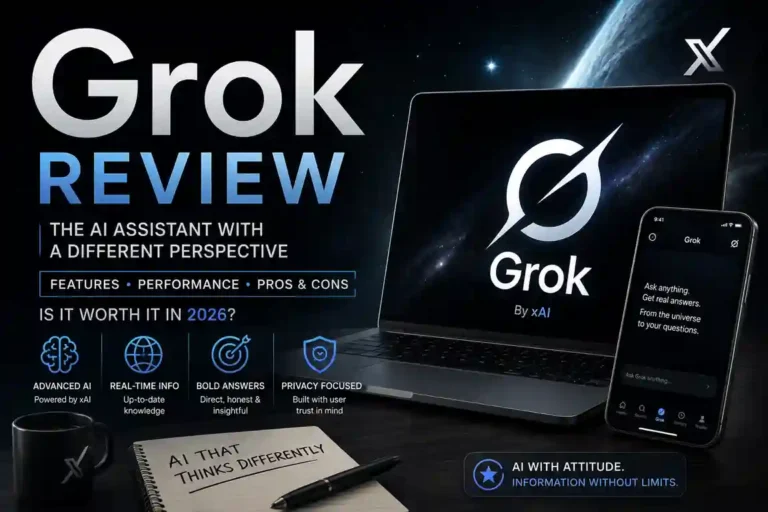
Grok is xAI’s AI assistant, built by Elon Musk’s AI company and tightly integrated with X (formerly Twitter). It launched in late 2023, and by 2026 has evolved into a genuinely competitive product with a distinct set of advantages that no other AI platform replicates. This review covers what Grok actually does in 2026, where it earns its place, and who it is — and isn’t — right for.
Grok review: the quick verdict
Grok 3 is a capable, fast model with two genuine differentiators: real-time access to X’s full post database, and a less restricted response style than ChatGPT or Claude. For users who live on X, track breaking news, want an AI that doesn’t hedge excessively, or need current social sentiment data, Grok is the most useful tool available. For general professional use, writing quality, long document analysis, or reliable reasoning depth, the leading alternatives remain stronger.
Best for: real-time information from X, breaking news research, social sentiment analysis, less filtered creative and conversational AI, and users already paying for X Premium.
Less suitable for: deep document analysis, complex multi-step coding, nuanced long-form professional writing, or users who prefer carefully cautious responses.
Recommended approach: try the free tier at grok.com or via X Premium before paying for SuperGrok — the gap between free and paid is real, but test the model against your actual use cases first.
What is Grok?
Grok is the AI assistant built by xAI, accessible through grok.com, the X mobile app, and X’s desktop interface. It runs on the Grok 3 model family, which includes a standard version and a reasoning-optimised variant (Grok 3 Think) for problems that benefit from extended step-by-step analysis.
Unlike ChatGPT or Claude, Grok’s most distinctive capability is native access to X’s real-time post stream — the full firehose of public posts, not a delayed or filtered sample. This is not a web search integration bolted on; it is a first-party connection to X’s data infrastructure that no competitor can replicate.
The models in 2026
Grok 3 is xAI’s flagship model. It handles text, images (input), and generates images via Aurora. It benchmarks competitively against GPT-4o and Claude on general tasks, though performance varies meaningfully by task type.
Grok 3 Think is the reasoning-optimised version, designed for mathematics, logic problems, coding challenges, and research synthesis. It takes longer to respond but applies extended chain-of-thought reasoning before producing output, reducing errors on structured analytical tasks.
Grok 3 mini is a faster, lighter model used for lower-stakes queries and available on free-tier access.
The features that matter most
Real-time X access
This is Grok’s most important differentiator and the reason to use it over any alternative for certain tasks. Grok can search and analyse the full X post database in real time — not just links that made it into web indexes, but posts from minutes ago. This makes it uniquely useful for:
- Tracking breaking news before major outlets have covered it
- Researching what people are actually saying about a product, company, or event right now
- Monitoring brand sentiment or competitor activity on X
- Finding expert reactions to a scientific paper, policy decision, or market event within hours of publication
No other major AI assistant has this capability at the same depth and recency. For journalists, market researchers, social media professionals, and anyone whose work requires understanding public conversation as it happens, this is a genuine competitive advantage.
DeepSearch
DeepSearch is Grok’s multi-step web research mode. Rather than retrieving a single set of results, it runs iterative searches, identifies gaps in the information, and continues searching until it has assembled a comprehensive answer. It cites sources and produces structured summaries. The quality is strong for research tasks where breadth and recency both matter — particularly for topics where X conversation and web sources together give a fuller picture than either alone.
Aurora image generation
Aurora is xAI’s image generation model, integrated directly into Grok. It produces photorealistic images, illustrations, and stylised output from text prompts. Image quality is competitive with DALL-E 3 on photorealistic scenes; stylistic versatility is slightly narrower. It is available on paid plans and generates images without some of the conservative content filters that restrict ChatGPT’s image output — which matters for creative professionals working on edgier or more experimental projects.
Grok 3 Think (reasoning mode)
Think mode activates extended reasoning before Grok produces a response. It is useful for maths problems, logic puzzles, code debugging, and research questions with multiple competing answers. The quality improvement over standard Grok on genuinely difficult reasoning tasks is noticeable. It is slower — responses can take 30 seconds to several minutes — but meaningfully more reliable on the task types it is designed for.
Voice mode
Grok includes voice interaction through the X and Grok mobile apps. It handles real-time spoken conversation, supports follow-up questions, and integrates X search into voice queries — so you can ask what people are saying about something on X and get a spoken summary. The voice quality is natural and the integration with X data distinguishes it from generic voice assistants.
Personality and response style
Grok is intentionally less filtered than its competitors. It will engage with hypothetical scenarios, edgy humour, political topics, and controversial questions that ChatGPT or Claude typically deflect or hedge around. This is either a feature or a bug depending on your use case. For creative writers, political commentators, entertainers, or users who find corporate AI hedging frustrating, the directness is valuable. For professional or regulated environments, the same directness requires more oversight on outputs.
Grok pricing in 2026
| Plan | Monthly cost | Key inclusions |
|---|---|---|
| Free (grok.com) | £0 | Grok 3 mini, limited Grok 3 access, basic image generation |
| X Premium | £8/month | Full Grok 3 access, DeepSearch, Aurora images, X platform features |
| X Premium+ | £16/month | Higher Grok usage limits, priority access, all X Premium features |
| SuperGrok | £25/month | Maximum Grok 3 and Think access, highest image generation limits, early feature access |
The most interesting pricing consideration: if you already use X actively and pay for X Premium, Grok’s core capabilities are included at no additional cost. For users who are not already on X Premium and want Grok primarily as an AI assistant, SuperGrok at £25/month competes directly with ChatGPT Plus (£20/month) and Claude Pro (£18/month) — at a price premium that is only justified if the X data access is central to your use case.
Strengths and limitations
Where Grok is strong
Real-time X data is genuinely unique. No competitor offers this. If your work involves monitoring public conversation, researching emerging stories, or understanding social sentiment as it develops, Grok is categorically more useful than alternatives for those specific tasks.
Less hedged responses. Grok engages with a wider range of questions without reflexively qualifying every answer or declining to engage. For users who find the conservative guardrails of ChatGPT and Claude frustrating for legitimate creative or research work, the difference is material.
Aurora image output. The image generation quality is competitive, and the content flexibility gives creative users more room than DALL-E 3’s stricter filters allow.
Speed. Standard Grok 3 responses are fast — often faster than GPT-4o at equivalent task complexity.
DeepSearch quality. For research tasks combining web and X data, DeepSearch produces thorough, well-cited outputs that reflect a broader information landscape than web-only search.
Where Grok falls short
Weaker on long documents. Grok’s effective handling of very long uploaded documents lags behind Claude, which processes lengthy contracts, reports, and research papers with greater accuracy and instruction-following precision.
Less consistent on complex coding. On nuanced multi-file coding tasks and debugging sessions requiring sustained context, ChatGPT with code interpreter and Claude tend to outperform Grok 3 in reliability, though Think mode narrows the gap on isolated reasoning problems.
Platform dependency. Grok’s best features are tied to the X ecosystem. Its value partially depends on X remaining a relevant platform for the conversations that matter to your work. For users who have reduced or abandoned X usage, this integration advantage is reduced.
Smaller developer ecosystem. xAI has an API, but the third-party integration ecosystem around Grok is substantially smaller than the one built around GPT-4 or Claude. Fewer tools, plugins, and workflows exist for teams building on top of Grok.
Trust and institutional credibility. Some organisations are cautious about deploying Grok in professional contexts given xAI’s association with X and the ongoing public debate about content moderation on the platform. This is a perception issue as much as a technical one, but it affects adoption decisions.
How Grok compares to ChatGPT and Claude
Grok’s X data access has no equivalent in either competitor — that point is not in dispute. Outside of that:
Against ChatGPT Plus: ChatGPT has a stronger ecosystem (custom GPTs, more integrations), more capable image generation in terms of stylistic range, better code interpreter with downloadable outputs, and more consistent performance on complex multi-step professional tasks. Grok is faster for simple queries and less filtered in its responses.
Against Claude: Claude has the clearest edge in long document analysis, instruction following for complex multi-stage tasks, and writing quality for editorial and professional contexts. Grok is less cautious in tone and has the real-time X advantage. Claude’s privacy-by-default stance is stronger; Grok’s data practices are tied to X’s infrastructure.
The honest summary: Grok is the best AI assistant for tasks that require real-time X data. For general professional AI use, it is a capable second choice, but not consistently ahead of the market leaders.
Privacy and data
Grok conversations may be used to train xAI’s models, subject to your privacy settings and the plan you are on. X’s data practices and privacy policies apply when using Grok through X’s apps. Users with sensitive data requirements should review xAI’s current privacy documentation before use and consider whether the X platform integration is appropriate for their organisational context.
For enterprise or regulated-industry use, review whether xAI offers data processing agreements with your required terms — the ecosystem is newer and less mature than OpenAI’s or Anthropic’s enterprise offerings in this regard.
Who should use Grok
Grok is a strong choice for:
- Journalists, researchers, and analysts who need real-time X data as part of their workflow
- Social media professionals monitoring brand, competitor, or sector conversations on X
- X Premium subscribers who want AI included without paying for a separate subscription
- Creative professionals who find ChatGPT’s content restrictions limiting
- Users who want fast, direct answers without excessive hedging
Grok is less suitable for:
- Professionals whose primary AI use involves long document analysis or complex instruction following
- Development teams building AI-integrated products who need a mature ecosystem
- Organisations with strict data governance requirements who need established enterprise agreements
- Users who have moved away from X and do not benefit from the platform integration
Recommended approach
If you are an active X user, start with X Premium — Grok access is included and the real-time X integration is the feature most worth evaluating. If X is not part of your workflow, use the free tier at grok.com to assess Grok 3’s general capability against your actual tasks before committing to SuperGrok. For most general professional AI use cases, ChatGPT Plus or Claude Pro will deliver more consistent results at a comparable or lower price. Grok earns its place as a primary tool when X data access is genuinely central to your work, or as a productive complement to a primary AI subscription for its directness and speed.